
The reception desk has long been the nerve center of business operations, the first point of contact that sets the tone for every customer interaction. But as labor costs soar and customer expectations evolve, forward-thinking businesses are increasingly turning to AI receptionist robots to revolutionize their front-line operations. The question isn’t whether this technology is impressive (it certainly is), but whether the investment makes financial sense for your business.
Having worked extensively with businesses implementing AI receptionist robots across various industries, I’ve witnessed firsthand both the transformative successes and the learning curves that come with this technology. The decision to deploy AI receptionist robots isn’t just about keeping up with trends, it’s about fundamentally reshaping how your business operates, scales, and serves customers.
The True Cost of Traditional Reception Services
Before diving into AI receptionist robots, let’s examine the hidden costs of traditional reception services that many businesses overlook. A full-time receptionist earning $35,000 annually actually costs your business significantly more when you factor in benefits, payroll taxes, training, sick days, and vacation coverage. The real annual cost often exceeds $50,000 per position.
For businesses requiring extended hours or 24/7 coverage, this cost multiplies dramatically. A retail location operating 16 hours daily would need at least two full-time positions, while a hotel or healthcare facility requiring round-the-clock coverage might need three to four receptionists to account for shifts, breaks, and time off. Suddenly, you’re looking at $150,000 to $200,000 in annual staffing costs for comprehensive coverage.
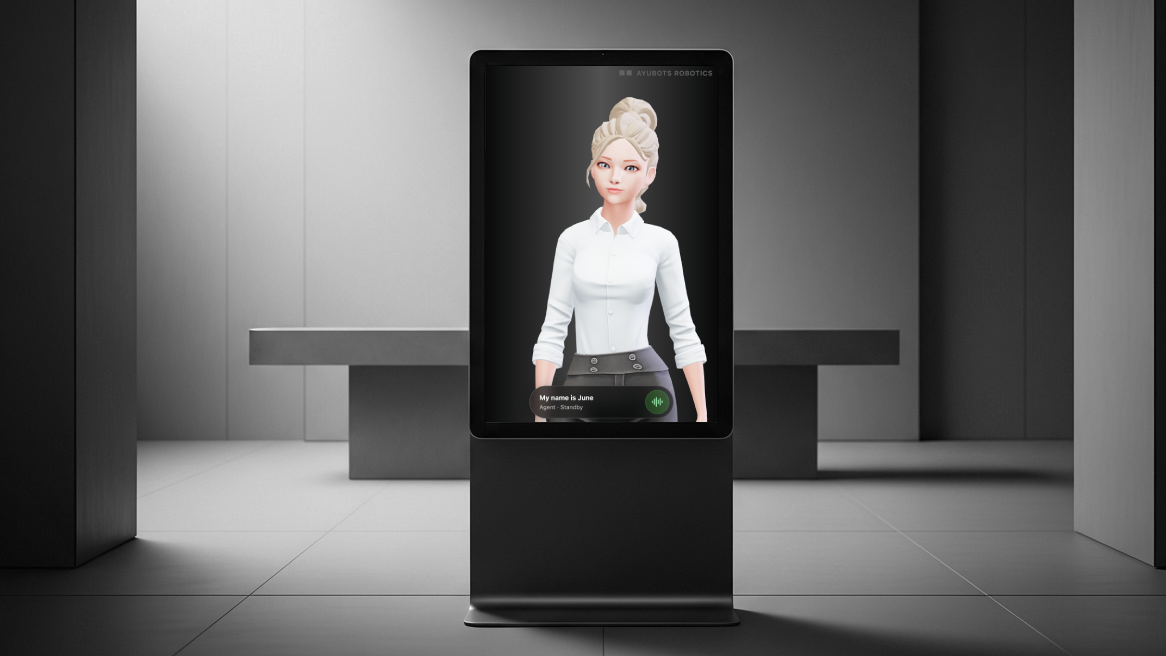
AI receptionist robots present a compelling alternative, with solutions like Spatial Agents starting at $60 per month per agent, effectively 10 cents per hour. Even accounting for additional costs like hardware, setup, and maintenance, the mathematics are striking: what costs $50,000 annually in human staffing can be replaced with a solution costing under $2,000 per year.
Breaking Down the Benefits
Unmatched Availability and Consistency
AI receptionist robots deliver perhaps their greatest value through absolute reliability. They don’t call in sick, take vacation days, or have off days that affect their performance. This consistency proves particularly valuable for businesses where first impressions are crucial, luxury hotels, medical practices, or high-end retail environments where service quality directly impacts customer satisfaction and retention.
Modern AI receptionist robots offer sophisticated natural language processing that enables fluid, contextual conversations. Unlike the rigid, menu-driven interactions of older automated systems, today’s solutions can understand complex queries, provide detailed responses, and seamlessly handle the majority of routine inquiries that typically occupy 60-80% of a human receptionist’s time.
Scalability Without Complexity
Perhaps the most compelling advantage of AI receptionist robots lies in their scalability. Adding a second location doesn’t mean going through another hiring process, training period, or ongoing HR management. You simply deploy another agent with identical training and capabilities. This scalability becomes particularly powerful for growing businesses or franchises where consistency across locations is paramount.
The technology also eliminates geographical constraints. A single AI receptionist robot can theoretically serve customers in multiple time zones simultaneously, speaking various languages with equal fluency. This global capability opens opportunities for businesses to extend their service hours or reach international customers without the complexity of managing distributed human teams.
Data Integration and Intelligence
AI receptionist robots excel at tasks that challenge human receptionists, perfect recall of company information, instant access to schedules and availability, and seamless integration with business systems. They can check appointment availability in real-time, collect customer information accurately, and even guide visitors through complex multi-step processes without forgetting details or making transcription errors.
This integration capability extends beyond basic receptionist duties. Advanced AI receptionist robots can analyze conversation patterns, identify frequently asked questions, and provide insights into customer needs and behavior patterns that inform broader business decisions.
The Investment Reality Check
While the ongoing operational costs of AI receptionist robots are significantly lower than human staff, the initial implementation requires thoughtful planning and investment. Quality hardware for deployment, whether tablets, digital kiosks, or custom installations, can range from $500 for basic setups to $5,000 or more for premium implementations.
The training and customization phase, while less intensive than hiring and training human staff, still requires time investment from business owners or managers. Your AI receptionist robot needs to learn your business’s specific processes, terminology, and brand voice. This initial training period typically spans several days to weeks, depending on complexity.
Integration costs can vary significantly based on your existing systems. Businesses with modern, API-friendly software ecosystems often find integration straightforward, while those with legacy systems may require additional development work or workarounds.

Industry-Specific Considerations
Retail and Hospitality
Retail environments benefit enormously from AI receptionist robots’ ability to provide product information, handle basic customer service inquiries, and guide customers through stores. The technology particularly shines in environments with high customer volumes but relatively standardized interactions, think shopping malls, airports, or large retail chains.
Hotels and hospitality businesses find AI receptionist robots valuable for handling check-in processes, providing local recommendations, and managing routine guest inquiries. The 24/7 availability particularly appeals to properties serving international guests across time zones.
Healthcare and Professional Services
Medical practices and professional service firms often deploy AI receptionist robots to handle appointment scheduling, provide basic information about services, and manage patient/client check-ins. The consistent, professional demeanor and perfect recall of protocols prove particularly valuable in these environments where accuracy and professionalism are non-negotiable.
However, these industries also present unique challenges. Healthcare environments require strict compliance with privacy regulations, while professional services often involve complex, nuanced client needs that may exceed current AI capabilities.
The Limitations You Should Know
Despite their impressive capabilities, AI receptionist robots have clear limitations that businesses must understand. They struggle with highly emotional situations, complex problem-solving scenarios, and situations requiring human empathy or judgment. A customer having a serious complaint or dealing with a personal crisis will likely need human intervention.
The technology also faces challenges with certain customer demographics. Older customers or those uncomfortable with technology might prefer human interaction, potentially creating customer service gaps. Cultural factors can also influence acceptance, with some regions or customer bases showing more resistance to AI-powered service.
Technical dependencies create another consideration. AI receptionist robots require stable internet connectivity, regular software updates, and ongoing technical maintenance. Businesses in areas with unreliable internet or those lacking technical support capabilities may find these requirements challenging.
Measuring Return on Investment
Calculating ROI for AI receptionist robots extends beyond simple cost comparisons. While the direct cost savings are often substantial, businesses should also consider indirect benefits like improved data collection, consistent service quality, and the ability to redeploy human staff to higher-value activities.
Most businesses implementing AI receptionist robots report positive ROI within 6-12 months, primarily through reduced labor costs. However, the most successful implementations also see improvements in customer satisfaction scores, reduced wait times, and increased operational efficiency.
The key to successful ROI measurement lies in establishing clear metrics before implementation. Track customer satisfaction, response times, inquiry resolution rates, and cost-per-interaction to build a comprehensive picture of the technology’s impact.
Making the Decision
AI receptionist robots represent a significant opportunity for businesses seeking to reduce costs while improving service consistency and availability. The technology has matured to the point where implementation risks are minimal, and the potential benefits are substantial.
The decision ultimately depends on your business’s specific circumstances: customer volume, service complexity, growth plans, and tolerance for technology adoption. Businesses with high-volume, routine customer interactions and plans for expansion will likely see the greatest benefits.
For businesses considering this technology, start with a pilot implementation in a single location or for specific use cases. This approach allows you to measure real-world performance, understand integration requirements, and build confidence in the technology before broader deployment.
The question isn’t whether AI receptionist robots will eventually become commonplace, they almost certainly will. The question is whether your business will be among the early adopters that gain competitive advantage through lower costs, better service consistency, and enhanced scalability, or whether you’ll be playing catch-up in a few years when this technology becomes standard practice.
The mathematics are compelling, the technology is proven, and the competitive advantages are clear. For most businesses, AI receptionist robots aren’t just worth the investment, they’re becoming essential for staying competitive in an increasingly automated world.