
The Definitive Guide to Automated Reception and Customer Interaction
The first impression a visitor has of any business, be it a corporate headquarters, a bustling hotel lobby, a modern clinic, or a retail outlet, is almost universally mediated by the front desk. This critical point of contact sets the tone for the entire experience. For decades, the front desk has been a bastion of human-centric interaction, requiring dedicated staff, extensive training, and often, round-the-clock availability.
However, the rapid acceleration of artificial intelligence has introduced a paradigm shift: the emergence of the AI front desk.
The AI front desk is not simply a futuristic concept; it is a current reality transforming operational efficiency and customer experience across industries worldwide. This technology represents the intelligent convergence of advanced machine learning, lifelike virtual interaction, and physical space integration. It is the automated, ever-present, and consistently knowledgeable face of a modern enterprise.
This comprehensive guide will define the AI front desk, dissect the intricate technologies that power it, outline its core functions, and provide a clear example of how cutting-edge solutions are realizing this potential today. Our objective is to serve as an informational, educational, and report-style resource, ensuring a deep understanding of this essential technological shift.
1. Decoding the AI Front Desk: Definition and Scope
A defining characteristic of modern operational technology is the ability to automate routine tasks while elevating the quality of human-to-human interaction. The AI front desk sits squarely at this intersection.
The Comprehensive Definition
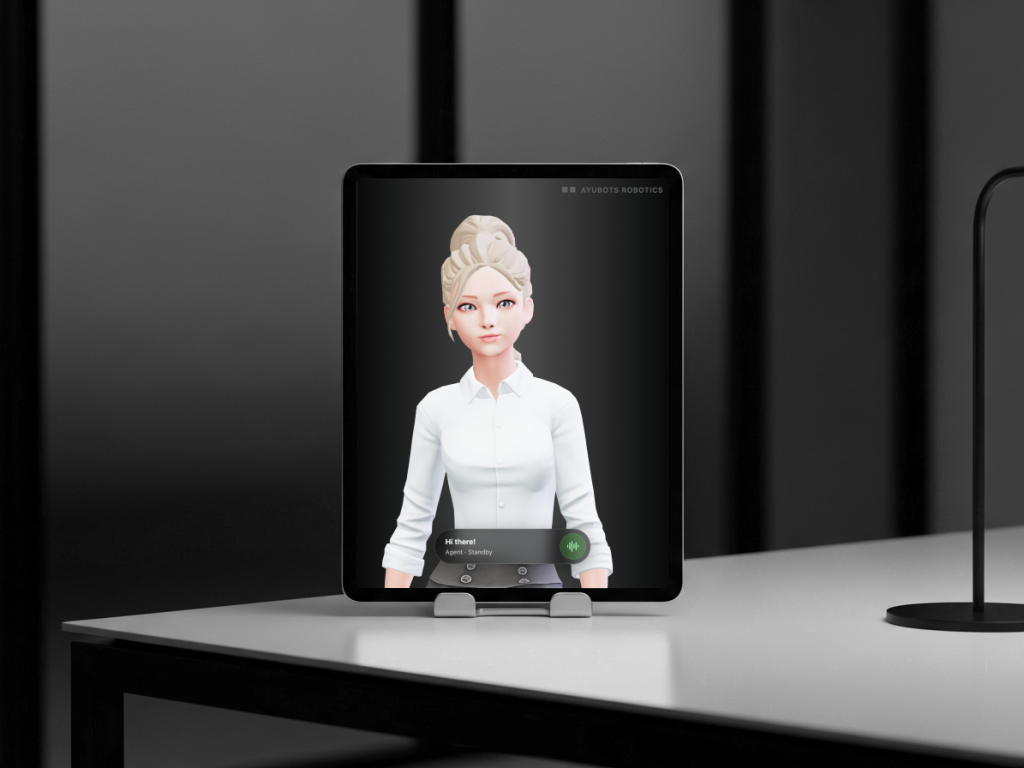
An AI front desk is a specialized, intelligent system designed to autonomously handle the core responsibilities of a traditional human receptionist or customer service agent in a physical environment. Unlike simple voice response systems or website chatbots, the AI front desk operates on a dedicated physical interface, typically a digital kiosk, tablet, or display; and is built for multimodal interaction.
Its core mission is to provide seamless, instant, and personalized service 24 hours a day, seven days a week. It acts as a concierge, a guide, a gatekeeper, and an administrative assistant, all rolled into one virtual presence.
The distinction between a generic AI assistant and an AI front desk lies in its spatial awareness and operational focus. It is trained specifically on the context of a physical location—a lobby’s layout, a list of internal employees, a hotel’s amenities, or a clinic’s check-in procedure. This focus allows it to handle real-world tasks that impact workflow and physical access, making it a critical infrastructure component rather than just a software utility.
Evolution from Predecessors
To appreciate the sophistication of the modern AI front desk, it helps to understand what it is not:
- Not a Simple Kiosk: Traditional self-service kiosks are rigid, menu-driven, and require the user to navigate predefined pathways. If a question is outside the programmed flowchart, the interaction fails.
- Not a Website Chatbot: While both rely on Large Language Models (LLMs), a website chatbot is purely text-based and lacks the ability to integrate with the physical environment or manage in-person logistics.
- Not a Humanoid Robot: While the physical interface can sometimes be a robot, the core innovation lies in the intelligence and personality displayed on a screen, offering a high-quality, low-complexity, and widely deployable solution. The modern AI front desk prioritizes lifelike, natural interaction without requiring specialized, costly, and complex mobile hardware.
The current generation of AI front desk solutions combines lifelike personalities with robust administrative capabilities, creating a virtual employee that is surprisingly lifelike, highly adaptable, and infinitely scalable.
2. The Technological Triad: Components of the AI Front Desk Mechanism
The operation of an AI front desk relies on a sophisticated technological stack. It functions through a continuous loop of sensing, processing, understanding, and responding. This mechanism is primarily driven by a triad of advanced technologies: Natural Language Processing (NLP), Computer Vision, and a proprietary, context-aware Knowledge Graph.
2.1. Natural Language Processing (NLP) and Speech Recognition
The ability of an AI front desk to hold a natural conversation is paramount. This is powered by cutting-edge NLP and speech-to-text engines:
- Voice Input and Transcription: High-quality microphones capture the visitor’s speech, which is then transcribed into text in real-time. This system must be robust enough to filter out background noise prevalent in lobbies and adjust for varying accents and volumes.
- Semantic Understanding: The NLP engine goes beyond keyword matching to determine the user’s intent, context, and emotional tone. If a visitor asks, “I have a meeting with Mr. Smith in the marketing department, where is that?” the system parses the intention (navigation/guidance) and extracts the key entities (Mr. Smith, marketing department).
- Context Management: Modern AI front desk solutions maintain conversation history, allowing for natural, fluid dialogue. The agent can remember previous inquiries and refer back to them, moving beyond single-turn interactions to deliver a truly lifelike experience. Furthermore, top-tier systems can operate in and translate between multiple languages instantly, offering global accessibility.
2.2. The Knowledge Graph and Learning Backend
This is the “brain” of the operation, where the business-specific intelligence resides.
- Proprietary Contextual Training: Unlike generic AI, an effective AI front desk is trained on the business’s specific data, including employee directories, floor plans, standard operating procedures, and product catalogs. This knowledge is organized into a searchable, contextual graph.
- Adaptive Learning: The best systems employ a unique, iterative training process. They don’t just passively ingest documents; they actively “learn” by engaging with human trainers (business owners or managers), asking clarifying questions to build expertise—much like a human employee would during an onboarding process.
- Integration Layer: The AI front desk must integrate with existing business tools, such as calendaring systems (for scheduling), Customer Relationship Management (CRM) tools (for logging interactions), and security systems (for issuing digital credentials). This integration is what transforms a simple conversational tool into a functional virtual employee.
3. Beyond Greeting: Core Functions and Operational Capabilities
The versatility of the AI front desk makes it a valuable asset in myriad environments, from high-security corporate offices to customer-intensive hospitality settings. Its functional scope is extensive, covering logistics, administration, and support.
3.1. Visitor Management and Check-In
This is the most fundamental function, yet it is executed with efficiency and precision unmatched by human processes:
- Automated Registration: The agent can guide a visitor through a complete self-check-in process, verifying appointments against a live calendar, capturing necessary details, and having non-disclosure agreements (NDAs) signed digitally on the screen.
- Credential Issuance: Once checked in, the system can autonomously issue temporary access passes, print visitor badges, or even send digital entry codes via email or text message.
- Host Notification: The AI doesn’t just check the visitor in; it immediately contacts the intended host via their preferred channel (SMS, internal chat, or email) to alert them that their guest has arrived.
3.2. Information and Navigation Concierge
An AI front desk eliminates the need for a visitor to ever feel lost or uninformed in a large facility.
- Wayfinding: Visitors can ask for directions in plain language (“How do I get to the fourth-floor conference room?”) and receive clear, verbal instructions accompanied by digital maps on the screen.
- Resource Retrieval: The agent can instantly retrieve and share crucial information, such as Wi-Fi passwords, facility operating hours, or detailed product specifications.
- Action Links and QR Codes: For the transmission of complex data or links, an advanced AI front desk can generate instant, scannable QR codes that link directly to forms, contact cards, or specific web pages, bridging the gap between the physical interaction and digital resources.
3.3. Administrative and Team Support
The value of the AI front desk extends internally, providing support to human teams.
- Internal Support Desk: Staff can interact with the agent for quick access to internal policies, IT troubleshooting tips, or general HR queries, freeing up dedicated personnel.
- Intelligent Escalation: A critical feature is the ability to recognize when a query exceeds its capabilities (e.g., requires complex human judgment or handling sensitive personal issues). In such cases, the agent acts as a Team Player, seamlessly escalating the interaction to the appropriate human employee, providing them with the full chat history for context.
4. The Evolution of Presence: Spatial Agents
As the demand for more lifelike, integrated, and effective AI front desk solutions grows, specialized categories of AI agents have emerged to meet these complex needs. Among the most definitive examples of this next-generation technology are Spatial Agents.
Spatial Agents represent an evolution in the AI front desk concept, moving beyond simple information kiosks to embody intelligent, virtual employees capable of operating autonomously within the physical footprint of a business. These agents are designed specifically to handle customer-facing roles—from receptionists and product experts to virtual guides—by blending natural conversation with distinct, lifelike personalities.
4.1. Lifelike Engagement and Personality
A core differentiator of Spatial Agents is the emphasis on high-fidelity, lifelike interaction. They utilize advanced rendering and voice technology to create a presence that is natural, expressive, and engaging. This isn’t just a technical achievement; it’s an operational one, as customers are proven to respond better to an agent that feels familiar and human-like, yet still recognizes its virtual nature.
This approach resolves the common “uncanny valley” problem by providing a conversational experience that mirrors a real person’s clarity and perfect understanding, making the interaction feel valuable and personal.
4.2. Designed for the Real World (Plug & Play Deployment)
The utility of a specialized AI front desk solution like Spatial Agents is defined by its accessibility and ease of deployment. They are built to be platform-agnostic, transforming existing hardware into powerful reception hubs.
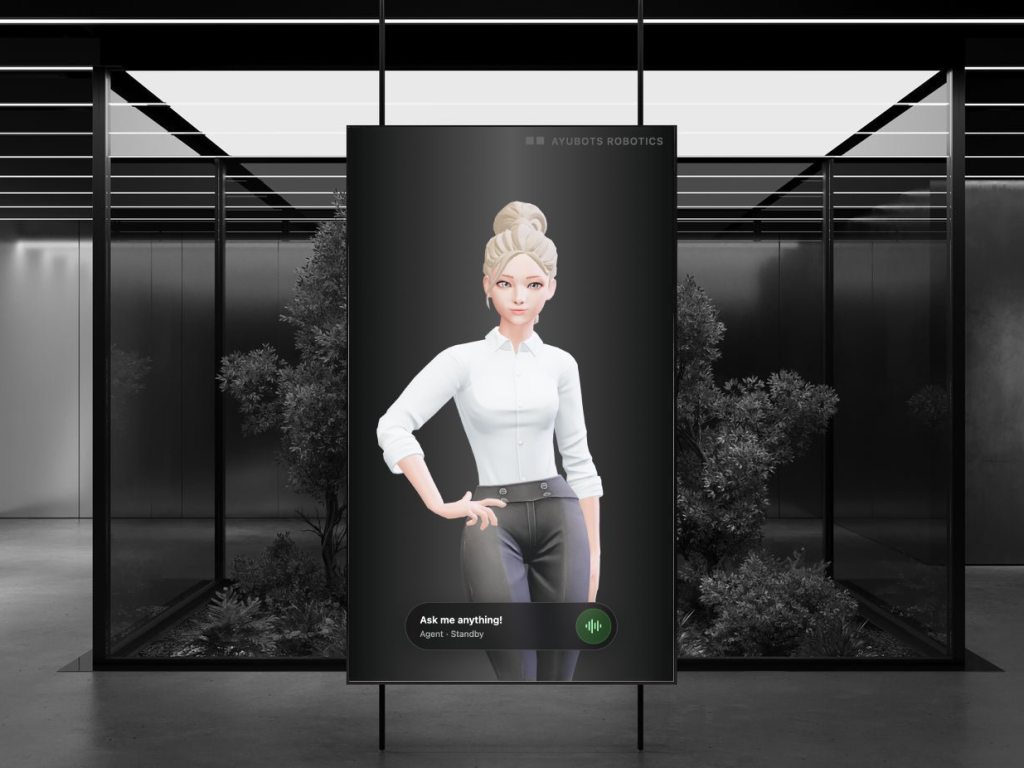
- Kiosk and Digital Signage Integration: Spatial Agents seamlessly integrate into existing digital signage displays in lobbies or high-traffic areas, transforming static advertising banners into interactive, high-visibility points of service. This makes the implementation straightforward and capital-efficient.
- Tablets and Counter-Top Devices: For smaller businesses or personalized counter-top interactions, the agents function perfectly on standard tablets and iPads, offering versatile, one-on-one engagement.
- Custom Hardware Versatility: The technology is robust enough to support highly specialized deployment, including interactive projections or large-scale video walls, allowing for immersive and unique brand experiences.
4.3. The Training Methodology: Building an Expert
The practical deployment of Spatial Agents follows a clear, three-step methodology:
- Create Agent: Select the desired personality and initial role (e.g., reception, sales support).
- Train: The agent is trained by conversing with a human manager. It actively asks questions about the business, products, and processes, internalizing the necessary domain expertise in a natural, conversational manner. This ensures the AI front desk is truly an expert on that specific business.
- Deploy Device: The trained agent is instantly deployed to any supported hardware; a kiosk, tablet, or custom display; ready to interact with customers in the physical space.
By delivering lifelike interaction, robust learning capabilities, and versatile deployment across standard business devices, solutions like Spatial Agents serve as a definitive example of how the AI front desk is moving from a concept to a reliable, scalable, and essential virtual employee for the customer-facing front lines.

5. The Business Case: Measurable Benefits and ROI of an AI Front Desk
Adopting an AI front desk is not merely a novelty; it is a strategic business decision that delivers tangible returns on investment (ROI) across operational efficiency, financial performance, and customer satisfaction.
5.1. Unprecedented Service Consistency and Availability
Human teams are subject to schedules, holidays, and variable performance based on stress or fatigue. An AI front desk operates with perfect, 24/7 consistency.
- Always On, Always Perfect: The system provides the same high-quality, professional interaction regardless of the time of day or the volume of queries. This ensures that every visitor, whether at 8 AM or 2 AM, receives instant, knowledgeable service.
- Multilingual Support at Scale: An AI system can instantly and flawlessly communicate in numerous languages (often 8 or more), instantly transforming a lobby into an international service hub without the need to hire specialized, rotating staff.
5.2. Cost Efficiency and Scalability
The financial benefits of utilizing an AI front desk are substantial and immediate.
- Reduced Labor Costs: While the intent is often to augment human staff rather than replace them, an AI front desk eliminates the need for round-the-clock staffing for repetitive, entry-level tasks. The cost of a virtual agent is exponentially lower than that of an equivalent full-time employee (FTE), delivering significant savings in overhead, benefits, and ongoing salary.
- Scalability without Infrastructure: When a business grows or opens a new location, replicating an AI agent’s expertise is instant and requires minimal setup. The business case scales effortlessly; deploying one hundred agents is as simple, and often as quick, as deploying one.
5.3. Elevating the Human Team
The introduction of an AI front desk fundamentally changes the role of human staff, allowing them to focus on high-value interactions.
- Focus on Complexity: By offloading repetitive administrative tasks (check-ins, basic directions, FAQ), human employees are freed up to handle complex, personalized, or emotionally sensitive customer issues that require true human judgment and empathy.
- Enhanced Customer Experience: When a visitor needs a human, they are connected instantly to an employee who is not fatigued by a day of repetitive greetings. This results in a higher quality, more satisfying interaction for both the employee and the customer.
6. Implementation Strategies and The Future Landscape
For businesses considering this technological leap, the path to implementation is streamlined, thanks to the advancements made by leading providers in the field. However, understanding the future trajectory of this technology is also crucial for long-term planning.
6.1. A Simple Path to Deployment
Adopting an AI front desk solution today can be surprisingly swift, moving through three core phases:
- Selection and Setup: The business selects the platform (e.g., a specialized Spatial Agent system) and determines the appropriate hardware—leveraging existing digital signage is often the quickest starting point.
- Training and Knowledge Transfer: This is the most critical phase. The agent’s knowledge base is established through structured data feeds (documents, databases) and, crucially, through conversational training with human supervisors. This process fine-tunes the AI’s personality and ensures absolute accuracy on business-specific details.
- Go-Live and Optimization: The agent is deployed. Post-launch, the system enters a continuous learning and optimization phase where performance metrics (query completion rate, customer sentiment) are monitored, and the knowledge graph is perpetually refined based on real-world interactions.
6.2. The Future of the AI Front Desk
The current generation of AI front desk technology is highly capable, but the future promises deeper, more pervasive integration that will further blur the lines between virtual and physical interaction.
- Multi-Modal Deep Fusion: Future systems will move beyond screen-based displays to incorporate interactive projections, holographic elements, and deeper integration with IoT (Internet of Things) sensors within the facility. Imagine an AI front desk that can automatically dim the lobby lights, adjust the temperature, and queue a presentation upon a visitor’s arrival, all in response to a verbal cue.
- Predictive Service: Utilizing the vast data collected from interactions, the AI front desk will become predictive. It won’t wait for a question; it will anticipate needs. For example, recognizing a frequent delivery driver, it might preemptively display the instructions for package drop-off before the driver even initiates a conversation.
- The AI-Human Team Paradigm: The most exciting trajectory is the development of truly collaborative environments. The AI front desk will function as the ultimate administrative support layer for human staff, scheduling meetings, gathering preliminary visitor information, and routing tasks based on real-time human availability, ensuring the combined human-AI team delivers optimal service every time.
Conclusion
The AI front desk represents one of the most significant operational advancements in modern business infrastructure. It is the definitive solution for achieving service excellence, operational efficiency, and scalable growth in environments where first impressions and continuous availability are non-negotiable.
By leveraging a sophisticated blend of NLP, computer vision, and context-aware AI, the AI front desk has evolved from a basic self-service tool into an intelligent, lifelike virtual employee. Specialized solutions like Spatial Agents are demonstrating the full potential of this shift, offering businesses a tangible, ready-to-deploy technology that transforms existing hardware into powerful customer interaction hubs.
As businesses continue to seek efficiency and unparalleled customer experience, the adoption of a professional, dedicated AI front desk is rapidly moving from an advantage to an essential operational standard. The future of reception is intelligent, available, and seamlessly integrated into the physical world.