
The landscape of retail, corporate, and public service environments is undergoing a dramatic transformation, moving from static, one way communication to personalized, dynamic interaction. Central to this paradigm shift is the emergence of the embodied avatar kiosk, a technology that blends the physicality of traditional information terminals with the cognitive power of artificial intelligence. This guide provides an in depth analysis of this revolutionary technology, defining its components, tracing its lineage from legacy digital signage, and exploring its transformative impact on customer experience and operational efficiency.
The concept of digital signage has long been recognized as a powerful tool for broadcasting information, but the latest iteration, driven by advanced AI, moves beyond simple display to true engagement. The fusion of conversational AI, photorealistic avatars, and specialized hardware creates the embodied avatar kiosk, ushering in the era of sophisticated AI Digital signage.
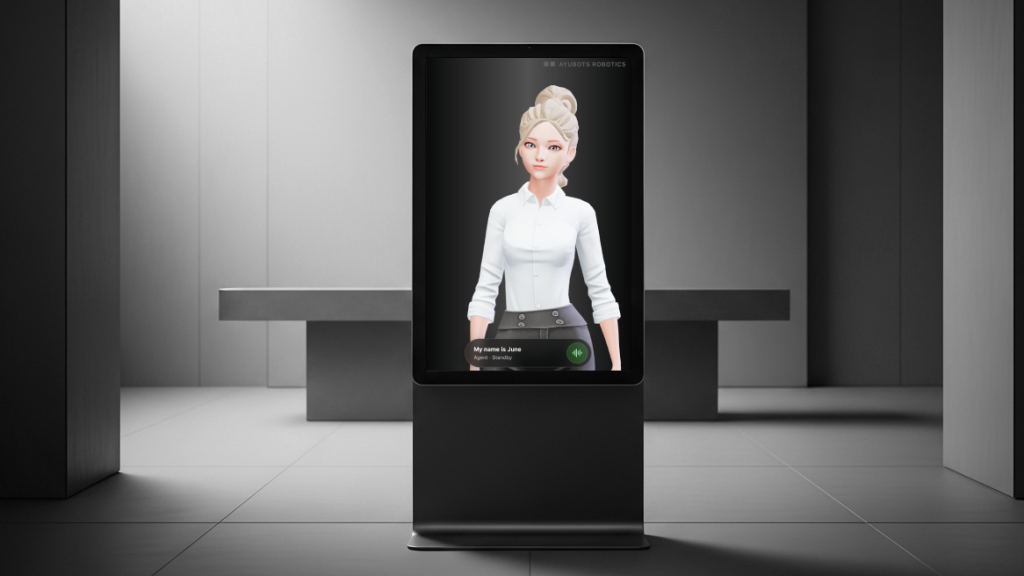
The Anatomy and Definition of an Embodied Avatar Kiosk
At its core, an embodied avatar kiosk is an interactive, standalone digital station featuring a visually rendered, intelligent conversational agent. Unlike a simple chatbot or voice assistant, the embodiment is key. This AI agent is given a face, a personality, and a presence, usually appearing on a large format display or specialized digital kiosk, making it feel less like a transaction and more like a human interaction.
The technology represents the highest echelon of interactive display systems, serving as virtual employees, guides, and specialists deployed directly on the front lines of business.
Defining Core Components
To function effectively, an embodied avatar kiosk relies on the seamless integration of three primary component stacks: the hardware shell, the software intelligence, and the visual embodiment.
1. The Hardware Shell (The Kiosk):
This is the physical platform that houses the technology. It typically includes a large high definition touchscreen display for the visual avatar, high quality microphones and speakers for seamless two way communication, and a robust processing unit capable of running the complex rendering and AI inference models. The kiosk design is critical, often needing to be sleek, durable, and designed for public accessibility and 24/7 operation. Essential hardware considerations include ensuring accessibility features are integrated, along with vandal resistance and environmental durability, depending on the deployment location. Furthermore, the modern iteration often integrates cameras for advanced computer vision capabilities, allowing the system to detect customer presence, gauge interest, and even analyze nonverbal cues like facial expressions or gaze direction. This sensory input is what moves the system beyond simple input output to truly contextualized interaction.
2. The Software Intelligence (The AI Brain):
This is the engine that powers the conversational ability. It leverages cutting edge advancements in large language models (LLMs) and natural language processing (NLP). The AI brain is responsible for understanding the user’s intent, synthesizing complex information, and generating humanlike responses. Critically, for business applications, this AI is trained not just on general knowledge, but also on proprietary business data, product catalogs, company policies, and frequently asked questions. The intelligence stack must also include mechanisms for learning and self correction, allowing the system to continuously improve its response accuracy and utility over time. The ability to integrate with existing customer relationship management (CRM) systems or enterprise resource planning (ERP) solutions further elevates the embodied avatar kiosk from a simple Q and A tool to a functional extension of the business infrastructure.
3. The Visual Embodiment (The Avatar):
This component provides the face and personality to the AI. Modern avatars are built using advanced 3D rendering and animation techniques to achieve photorealistic or highly stylized, yet natural, visual presence. The goal is to strike a perfect balance of being surprisingly lifelike without crossing into the “uncanny valley,” the psychological phenomenon where overly realistic but slightly imperfect human representations cause revulsion. The avatar handles the nonverbal communication, including gestures, facial expressions, and lip synchronization, making the interaction intuitive and engaging. The visual embodiment is a strategic decision for any brand, as the avatar essentially becomes a recognizable face for customer service, a highly scalable, digital employee that maintains brand consistency across all deployed locations. The choice of voice, accent, and mannerisms all contribute to this critical branding element.
The Evolution to AI Digital Signage
The concept of using screens in public spaces dates back decades, but the path from static posters to dynamic AI Digital signage is one of progressive technological integration. Understanding this evolution is crucial to appreciating the quantum leap represented by the embodied avatar kiosk.
Phase 1: Static and Loop Signage
In its earliest digital form, signage simply replaced printed posters. Screens displayed pre determined, time bound loops of advertisements or informational slides. Engagement was purely passive, relying solely on visual attention.
Phase 2: Interactive Digital Signage (IDS)
The introduction of touchscreens marked the next major step. This allowed users to navigate pre-loaded menus, search directories, or access basic FAQs. While interactive, the content was always constrained by the programmed decision tree. If a user asked a question outside the programmed path, the system failed, leading to frustration. This phase was characterized by a heavy reliance on rigid programming and fixed data structures.
Phase 3: AI Digital Signage
This current phase is defined by the integration of Generative AI. AI Digital signage is not just interactive; it is conversational and cognitive. It can handle novel questions, synthesize answers in real time, and personalize the conversation based on context and user input. The core limitation of older systems, the inability to handle unexpected input, is completely removed. This opens the door to truly versatile applications, moving the signage role from broadcasting to personalized service. It is within this category that the embodied avatar kiosk finds its definitive place, transforming a mere display into a conversational point of service. The transition from IDS to AI Digital signage means the kiosk is now a dynamic service agent rather than a passive information repository, offering true value addition to the customer journey.
Core Technologies and The Role of Embodiment
The functionality of the embodied avatar kiosk is a tapestry woven from several complex AI and cognitive technologies.
Conversational AI and LLMs
At the heart of the conversational ability are large language models. These models are responsible for the fluency and coherence of the dialogue. They enable the avatar to maintain context throughout a long conversation, understand slang, handle complex inquiries, and provide accurate, contextually relevant responses. The training of these LLMs often involves fine tuning them on specific industry vocabulary and business use cases, ensuring the avatar sounds like an expert in its field. The model’s speed and efficiency are paramount, as real time, low latency response is essential for a believable and frustration free conversational experience. A one second delay in response can break the illusion of genuine conversation.
Computer Vision
Integrated cameras and computer vision software allow the embodied avatar kiosk to perceive its environment. This capability facilitates crucial actions:
- Presence Detection: The system knows when a person approaches, allowing the avatar to initiate a greeting or service.
- Demographic Analysis: It can estimate age or gender for basic personalization, without requiring identifiable information.
- Mood Analysis: Basic detection of emotional state (e.g., frustration, curiosity) can allow the AI to adjust its tone or conversational approach.
- Gaze Tracking: The avatar can tell if the user is looking at the screen, maintaining eye contact in a lifelike manner during the conversation.
The Power of the Embodied Avatar
The avatar itself is not just a cosmetic feature; it is a critical interface element that enhances trust, clarity, and engagement. When the AI speaks through an embodied form, the information is processed by the human brain far more effectively than text or disembodied voice alone. The visual cues—a nod, a hand gesture, or subtle shift in posture—add layers of meaning, making complex instructions easier to follow and general interactions more comfortable. This is the ultimate differentiator between a generic chatbot and an embodied avatar kiosk: the creation of a socially acceptable, engaging, and context rich interaction. This physical presence transforms the kiosk from a utility into a digital colleague.
Leading Examples in Embodied Avatar Kiosk Technology
As this sector matures, various companies are pushing the boundaries of what is possible with AI Digital signage. One compelling development in the industry is the emergence of platforms designed specifically for creating and managing these lifelike digital employees. These offerings often position themselves as advanced Spatial agents, a category of AI designed for real world, customer facing interactions across physical locations.
These sophisticated platforms allow businesses to recruit, train, and deploy AI agents across various devices, essentially hiring digital staff for roles like receptionists, product experts, or guides. Platforms offering Spatial agents are built to handle the entire lifecycle of an embodied avatar kiosk deployment, from training the agent on proprietary business knowledge to integrating it seamlessly into existing digital signage or specialized hardware.
A definitive example of this approach is seen in leading solutions that offer lifelike AI agents for the front lines of business. They emphasize the balance between photorealistic quality and natural expressiveness, ensuring the digital agent is engaging without being unnerving. These agents are trained to learn continuously about a business by asking questions and integrating new information, operating much like a human employee being onboarded. They are designed to be plug and play, supporting deployment through standard tablets, existing digital signage, or even custom video walls, providing flexibility for businesses to leverage their current infrastructure. The versatility of these Spatial agents highlights the true potential of the embodied avatar kiosk concept, showing how a single platform can manage multilingual, highly specialized virtual staff across numerous locations at scale, fundamentally reducing overhead while dramatically increasing service availability and quality.

Practical Applications and Transformative Industry Impact
The deployment of the embodied avatar kiosk is not limited to a single sector; its versatility allows it to fundamentally reshape customer service across numerous industries, delivering significant return on investment (ROI).
Retail and E-commerce Integration
In retail, the embodied avatar kiosk acts as a hyper available, knowledgeable sales associate. It can greet customers, direct them to specific products, answer detailed questions about inventory, features, and pricing, and even process loyalty program sign ups. By integrating with the retailer’s inventory management system, the avatar can provide real time stock checks and recommend personalized items based on past purchase history or current trends. This frees human staff to focus on complex problem solving and value added sales activities, while the AI Digital signage handles the routine inquiries.
Healthcare and Patient Experience
In healthcare settings, these kiosks streamline the check in process, provide directions within a large facility, and answer basic medical or administrative FAQs. They can help patients navigate complex insurance forms or pre screening questionnaires in a supportive, humanlike manner, significantly reducing the administrative burden on nurses and receptionists, and allowing patients to receive essential information accurately and quickly in a private environment.
Hospitality and Travel
Hotels and airports are prime locations for the embodied avatar kiosk. In a hotel lobby, the avatar can serve as a 24/7 concierge, handling check in, explaining amenities, making restaurant recommendations, and providing information on local attractions. In airports, they can provide multilingual flight status updates, gate directions, and immigration information, dramatically improving passenger flow and reducing communication barriers in global hubs. The multilingual support characteristic of advanced Spatial agents is particularly valuable in this sector, enabling communication in over eight languages including English, Spanish, French, and Arabic.
Corporate and Educational Environments
For corporate offices, the embodied avatar kiosk functions as a highly professional and scalable receptionist, managing visitor sign in, notifying employees of arrivals, and providing building navigation. In educational settings, they can guide prospective students on campus tours, answer admissions questions, and direct visitors to specific departments or lecture halls.
The Economic and Operational Case for Embodiment
The decision to invest in an embodied avatar kiosk is underpinned by a compelling economic and operational rationale. The benefits extend far beyond mere novelty.
1. Scalability and Availability:
A digital agent never sleeps, never takes a sick day, and can be deployed in dozens or hundreds of locations simultaneously without additional training time. This ensures 24/7 service availability, a feat nearly impossible or prohibitively expensive to achieve with human staffing alone. The agent is always on brand and always consistent in its delivery of information, eliminating variations in service quality.
2. Cost Efficiency:
While the initial setup of an advanced AI Digital signage system requires investment, the operational costs are minuscule compared to human labor. Leading platforms demonstrate that the cost of running an agent can be extraordinarily low per hour, offering businesses a dramatic reduction in payroll expenses for customer facing roles, while providing a massive uplift in service throughput.
3. Data Collection and Insights:
Every interaction with an embodied avatar kiosk is a data point. The system records customer queries, common points of confusion, product interests, and behavioral patterns. This rich data stream provides invaluable business intelligence, helping companies refine their products, marketing strategies, and operational processes in a way that static signage or traditional service models simply cannot.
4. Enhanced Customer Experience (CX):
The true value lies in the humanization of the digital experience. By providing a face, a voice, and a personality, the embodied avatar kiosk makes technology approachable. Customers often feel more comfortable asking ’embarrassing’ or ‘basic’ questions to an AI agent than a human, leading to higher rates of engagement and satisfaction. The natural, lifelike conversational experience built into leading Spatial agents ensures that the interaction is productive and pleasant.
The Future Trajectory of Embodied Avatar Kiosk
The current generation of embodied avatar kiosk technology is highly impressive, yet it is merely the foundation for what is to come. The future of AI Digital signage is marked by a continued drive towards deeper integration with the physical world and heightened emotional intelligence.
Future embodied avatar kiosks will likely feature even more advanced sensory fusion, integrating haptic feedback, deeper environmental awareness, and the ability to interact with physical objects around them through robotics or augmented reality overlays. Imagine an avatar kiosk in a car showroom that can project information and features directly onto the vehicle itself while conversing with the customer.
Furthermore, the intelligence will evolve to not only understand what a customer is saying but also why they are saying it, enabling truly empathetic and proactive service. Agents will become capable of complex predictive analysis, anticipating needs before they are explicitly articulated. The proliferation of specialized Spatial agents tailored for niche industry roles will continue, making the embodied avatar kiosk an indispensable part of every customer facing operation.
The convergence of photorealism, sophisticated conversational AI, and versatile hardware has permanently altered the trajectory of digital communication in the physical world. The embodied avatar kiosk is no longer a futuristic concept; it is the definitive present and future of intelligent, scalable, and humanlike customer interaction, serving as a powerful and effective tool for businesses ready to embrace the new era of AI Digital signage.