
The business landscape has undergone a radical transformation in recent years, and nowhere is this more evident than in customer-facing roles. As we navigate through 2025, companies are increasingly asking themselves a critical question: should we stick with traditional virtual receptionists, or is it time to embrace the revolutionary capabilities of AI receptionist robots?
The answer isn’t just about cost-cutting or following trends – it’s about fundamentally reimagining how businesses interact with their customers. After extensive research and real-world implementations, the evidence is clear: AI receptionist robots are not just competing with virtual receptionists; they’re setting an entirely new standard for customer service excellence.
The Evolution of Front Desk Operations
Traditional virtual receptionists, while offering some advantages over in-person staff, still operate within human limitations. They work specific hours, require breaks, can have off days, and their availability is constrained by scheduling and human resources. Even the best virtual receptionist services struggle with consistency across different time zones and peak demand periods.
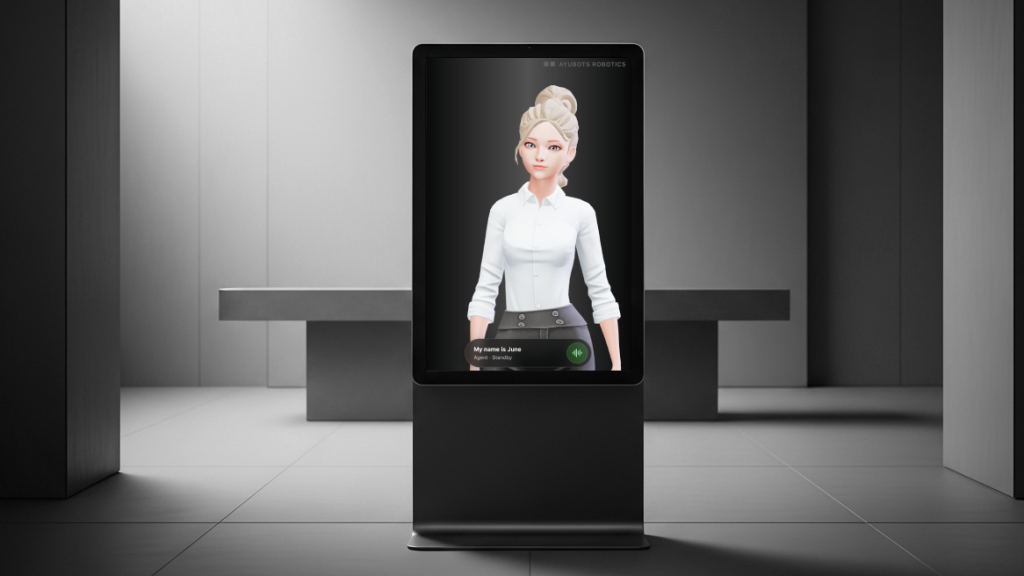
AI receptionist robots represent a quantum leap forward. These sophisticated systems combine lifelike 3D animated agents with natural language understanding to create an experience that feels remarkably human while delivering superhuman reliability. Unlike their virtual counterparts, AI receptionist robots never need coffee breaks, never call in sick, and maintain the same level of enthusiasm and professionalism at 3 AM as they do at 3 PM.
The Surprising Reality of Lifelike Interaction
One of the most compelling aspects of modern AI receptionist robots is their ability to strike the perfect balance between being lifelike and approachable without falling into the “uncanny valley” that plagued earlier attempts at digital humans. These systems use expressive facial animation and real-time voice interaction to create authentic customer experiences that feel natural and engaging.
The technology has reached a point where conversations flow exactly like talking to your best employee. Customers report clear speech, perfect understanding, and responses that actually make sense – a far cry from the robotic, scripted interactions of earlier AI systems. This natural conversation capability means that AI receptionist robots can handle complex inquiries, provide detailed information about products and services, and even engage in the kind of small talk that helps put visitors at ease.
24/7 Availability That Actually Works
While virtual receptionists can theoretically provide extended coverage through shift work and global teams, the reality is often fragmented service with varying quality levels. AI receptionist robots eliminate this inconsistency by providing truly uninterrupted 24/7 service. Whether a customer walks in at midnight or during peak business hours, they receive the same high-quality interaction.
This constant availability is particularly valuable for businesses operating across multiple time zones or those serving international customers. A hotel can provide seamless check-in assistance at any hour, a healthcare facility can offer appointment scheduling around the clock, and retail stores can maintain customer support even when human staff is unavailable.
The Intelligence Factor: Learning and Adapting
Modern AI receptionist robots don’t just follow scripts – they learn and evolve. These systems train themselves by conversing with business owners and managers, asking questions about products, services, and processes to build comprehensive expertise. This learning capability means that an AI receptionist robot becomes more valuable over time, developing deeper knowledge about the specific business it serves.
Unlike virtual receptionists who may require extensive training materials and regular updates, AI receptionist robots can quickly absorb new information through natural conversation. When a business launches a new product or changes its policies, updating the AI receptionist robot is as simple as having a conversation about the changes.
Cost-Effectiveness That Changes Everything
The financial advantages of AI receptionist robots are staggering. At approximately 10 cents per hour – around $60 per month for full-time operation – these systems cost less than a virtual receptionist would earn in a single hour. For small businesses that previously couldn’t justify the expense of a receptionist, this pricing makes professional front desk service accessible for the first time.
The cost comparison becomes even more favorable when considering the total value proposition. AI receptionist robots don’t require payroll taxes, benefits, vacation coverage, or management overhead. They don’t need training time to reach full productivity, and they don’t carry the risk of turnover that can disrupt customer service quality.
Deployment Flexibility and Scalability
AI receptionist robots offer unprecedented flexibility in deployment. They work seamlessly on tablets for personal interactions, digital kiosks for high-traffic areas, or even custom hardware installations for unique brand experiences. This adaptability means businesses can start small with a tablet-based solution and scale up to more sophisticated installations as their needs grow.
The plug-and-play nature of these systems is particularly appealing to businesses that want to avoid complex technical implementations. With basic requirements of a modern browser, touchscreen display, and internet connectivity, almost any business can deploy an AI receptionist robot quickly and easily.
Action-Oriented Capabilities
Beyond conversation, AI receptionist robots can take concrete actions to help customers. They can instantly share contact information through QR codes, pull up relevant forms and links, provide directions and wayfinding assistance, and even integrate with appointment scheduling systems. This action-oriented approach means they don’t just provide information – they facilitate actual business outcomes.
The ability to seamlessly hand off complex issues to human staff when needed demonstrates the collaborative potential of AI receptionist robots. They handle routine inquiries independently while ensuring that customers with specialized needs reach the right human expert efficiently.
Team Integration and Collaboration
Rather than replacing human staff, the best AI receptionist robots are designed to work alongside existing teams. They handle the routine questions and basic interactions that consume significant human time, freeing up staff to focus on more complex customer needs and business development activities.
This collaborative approach means that businesses can maintain the human touch where it matters most while leveraging AI efficiency for routine operations. The result is often improved job satisfaction for human employees who can engage in more meaningful work rather than repetitive reception tasks.
Looking Ahead: The Future of Reception
As we progress through 2025, the question isn’t whether AI receptionist robots are better than virtual receptionists – it’s whether businesses can afford to fall behind in customer experience innovation. The technology has matured to a point where it offers clear advantages in reliability, cost-effectiveness, availability, and scalability.
The businesses that embrace AI receptionist robots now are positioning themselves at the forefront of customer service evolution. They’re offering their customers the kind of consistent, available, and intelligent interaction that will become the expected standard across industries.
For businesses still relying on traditional virtual receptionist services, the time for consideration is rapidly passing. The combination of dramatically lower costs, superior availability, continuous learning capabilities, and seamless integration makes AI receptionist robots not just a viable alternative, but the obvious choice for forward-thinking organizations.
The revolution in front desk operations isn’t coming – it’s here. AI receptionist robots represent the practical, affordable, and effective way that businesses can elevate their customer experience while optimizing their operational efficiency. In 2025, the question isn’t whether to make the switch, but how quickly you can implement this transformative technology to stay competitive in an evolving marketplace.
The future of reception is artificial, intelligent, and surprisingly human – and it’s available today for the price of a few cups of coffee per day.